


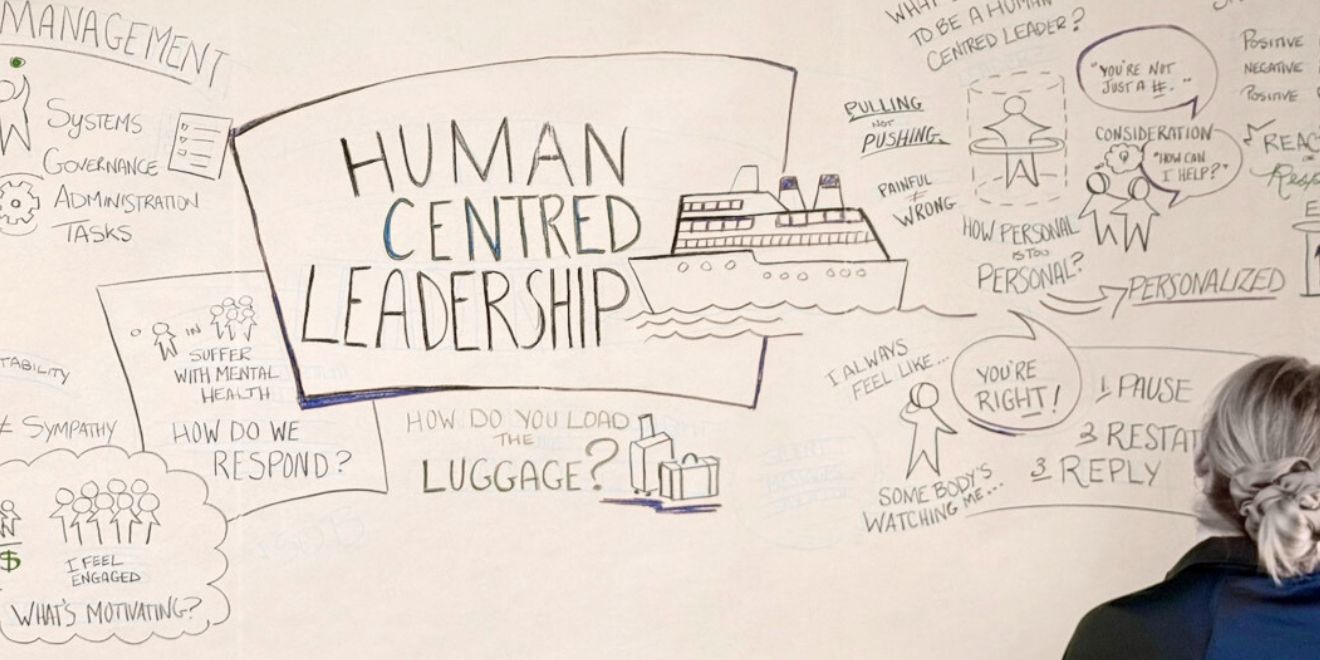
Our work environments are full of swirling bits of information, email threads, requests, meeting follow up items and ideas – each piece vying for our focus. What’s next isn’t always obvious. So how do you determine the most effective use of time and effort?
You can stick your hand in the whirlwind and work on the first thing you can catch.
Or you can hit pause and create clarity by making your thoughts visible.
When we pin our thoughts to paper, we externalize them. In other words, we create visual devices to help shift ideas from our heads into the real world. This simple shift changes how we think, problem solve, and how we work with others.
Visual thinking offers several advantages that make it particularly powerful in complex environments.
The Cognitive Advantage of Visual Thinking
Getting ideas out of our heads lowers our cognitive load.
It frees up mental space so that we no longer need to spend energy trying to remember what we’re trying to remember.
Our focus increases and we retain more because images act like mental hyperlinks, bringing back discussions, events and experiences.
The Spatial Advantages of Visual Thinking
What is a spatial advantage? It’s an unusual phrase in the context of communication. One helpful way to think about it is that very often, information is presented in text.
Text is linear.
Text on a page is great for communicating detail, but it can be difficult to absorb. The reader is limited to reading in a prescribed way – in English, that’s left to right, top to bottom. It can be difficult to move around the page, or across multiple pages, when you are trying to connect ideas.
Visual thinking is spatial. By nature, they use limited text and they often communicate meaning through metaphor. For example, in a recent discussion on empathy vs sympathy, the speaker described the difference by saying that if you had never had a pet, you could feel sympathy for a friend who lost their dog, but you can be empathetic if you’ve experienced losing a pet yourself. A simple drawing of a dog, acts as a metaphor for the conversation.
Drawings also allow ideas to sit beside or around each other. Because they don’t have to be “read” linearly, people make new associations and surface relationships.
Text needs to be absorbed, where an image can be taken in at a glance. A diagram gives people the freedom to choose what to look at, to consider the parts or the whole all at once, which is often what complexity demands.
The Process Advantage
Documentation records what we know. Visualization shows how we think – individually and as groups.
For teams, visual thinking increases clarity and reduces ambiguity. When we ‘sketch out’ our ideas “we can more easily invite others into our processes because they can see our purpose and goals. Visual tools make our decisions (or lack thereof) clear,” writes visual collaboration expert, Ole Qvist-Sorensen.[1]
But just because the vision is clear doesn’t mean that movement follows.
The Momentum Advantage of Visual Strategy
In a recent Harvard Business Review article, Your Strategy Needs A Visual Metaphor, researchers found that “participants exposed to diagrams with metaphor-based visualization reported significantly higher engagement” than those who only saw the standard diagram. The information conveyed didn’t change. What changed was how much people cared.
People may understand a plan and still feel disconnected from it. Metaphor and storytelling help translate abstract ideas into something relatable. When combined with visual thinking they create a visual journey – a roadmap – that can be updated to reflect and reinforce progress which helps keep the strategy alive in everyday work.
Our workplaces, and our lives, continually present high-speed challenges and create a complexity that isn’t going away any time soon. One of the most powerful responses we can make is to make our thinking visible.
When ideas move from our heads to the page, they stop competing for space in our minds. They become something that we can sort, sift through and build on.
In a world full of swirling ideas, clarity often begins with a simple act: drawing the first line.
Meaningful, stress free change starts with engaging your team in collaborative communication. Find out how CWE can facilitate the those conversations by learning more about membership today.