

When an IT department supports an entire organization, determining “priority” often feels like aiming at a moving target. At the University of Windsor, IT requests come from every corner of the campus, and each one is attached to a person convinced that their request should be first in line. This is something we commonly hear at roundtable discussions across industries.
So how do you bring clarity and establish trust?
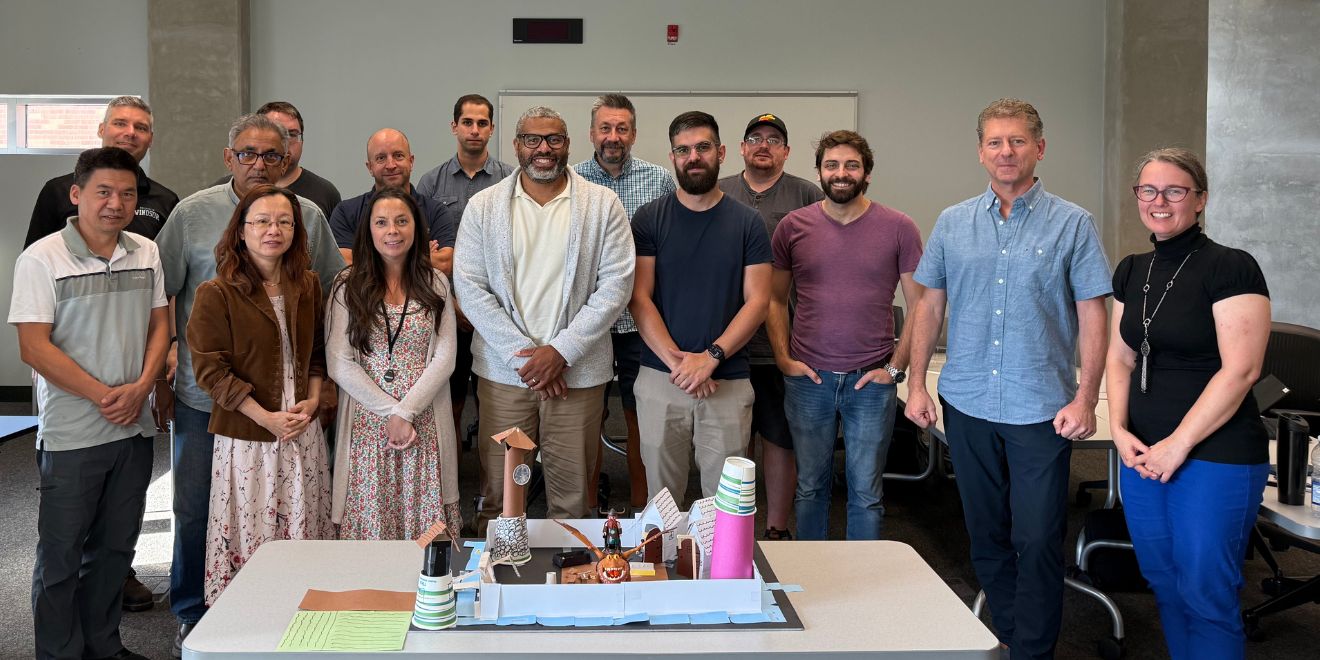
Header Image: Group 1 of the University of Windsor’s IT team putting in the work.
The IT department was split into three groups for Scrum Fundamentals – a full-day, interactive Scrum workshop.
We met with Marcin Pulcer (Associate Vice President – Information Technology Services), Nigel Bertrand (Director, Project Management & Business Applications – IT Services) and Michael Salvador (Manager, Web and Application Development) at the University of Windsor to learn how their IT team is rethinking ownership, prioritization and communication across campus.
The Challenge of Ownership
“We have a culture where if it’s digital, it’s an IT product.” Marcin Pulcer noted. But just because IT builds a tool doesn’t mean that IT should own it and set the long-term vision. It’s important to allow the folks who use the tools to manage them and consistently communicate what they need.
To that end, the university is working towards a collaborative approach to their work. “Tell us what you want to do with the application. You make the decisions about what’s next, and we’ll guide and make suggestions for how those decisions can happen from a technical perspective.” Michael Salvador explained.
This move toward application stewardship allows departments to create a vision that everyone can point back to when it’s time for decisions to be made. And the long-term thinking gives back some much-needed flexibility and agility to IT. But it’s only part of the equation.
When your department serves many masters, how do you prioritize work?
The Challenge of Shifting Priorities
Priorities can shift for different reasons.
Sometimes the vision changes within departments due to their own competing priorities. What was important two weeks ago, might not be today – leaving hours of effort on pause before it can deliver its value. All that unfinished work in progress can undermine the trust of any organization in their IT department.
Other times hierarchy shifts priority. Some requests outrank others. Emergencies happen. But when the triage process isn’t visible, reprioritization can seem arbitrary. Without transparency, people can feel that influence or persistence is what gets work done. That leads to work entering the funnel from all sorts of directions. “We want to give departments a way to understand our processes and see what’s still in our queue.” stated Nigel Bertrand. When decisions are opaque, people question the system and shadow IT and “work around” solutions grow.
The Challenge of Communication
Once you’ve established ownership and priority, how do you communicate it?
The IT department at the University of Windsor serves many different parts of the university – and they all have different “communication languages”. Even within their own department, teams use different language and approaches. That is why clarity and a shared understanding of the work is essential, “we want to create a structure for how, when and with whom we engage around campus” Bertrand said.
So, What Are You Going to Do About it?
It was clear to leadership that they needed a culture shift and a framework to guide it, but the beginning of the breakthrough didn’t come from a mandate. It came from a small experiment. Under Salvador’s management, one of his teams began experimenting with a “scrum-like” approach. The goal was to experiment with Scrum cycles to see if the framework built on transparency, inspection and adaptability would fit their context. It was an investment in people. Pulcer and Bertrand supported Salvador, and Salvador empowered his team. Over time, the team started seeing wins and wanted to move from “scrum-like” to a more formal understanding of the Scrum framework.
Leadership noticed the results.
“We wanted to continue the success that Michael’s team was seeing,” Pulcer explained. The pilot demonstrated that the structure could help the team, but it also revealed a gap. The team needed clear partners within departments to set the vision, prioritize and steward the value of their work. “We recognized that Product Ownership was the missing piece,” Bertrand added.
The university already had business analysts who often act as liaisons between IT and their departments, which made them a logical choice. But business analysts and product owners have different accountabilities. One gathers requirements. The other owns vision and value. If Scrum was going to work, it needed a shared language and understanding. Not just for IT teams, but for the outside world too.
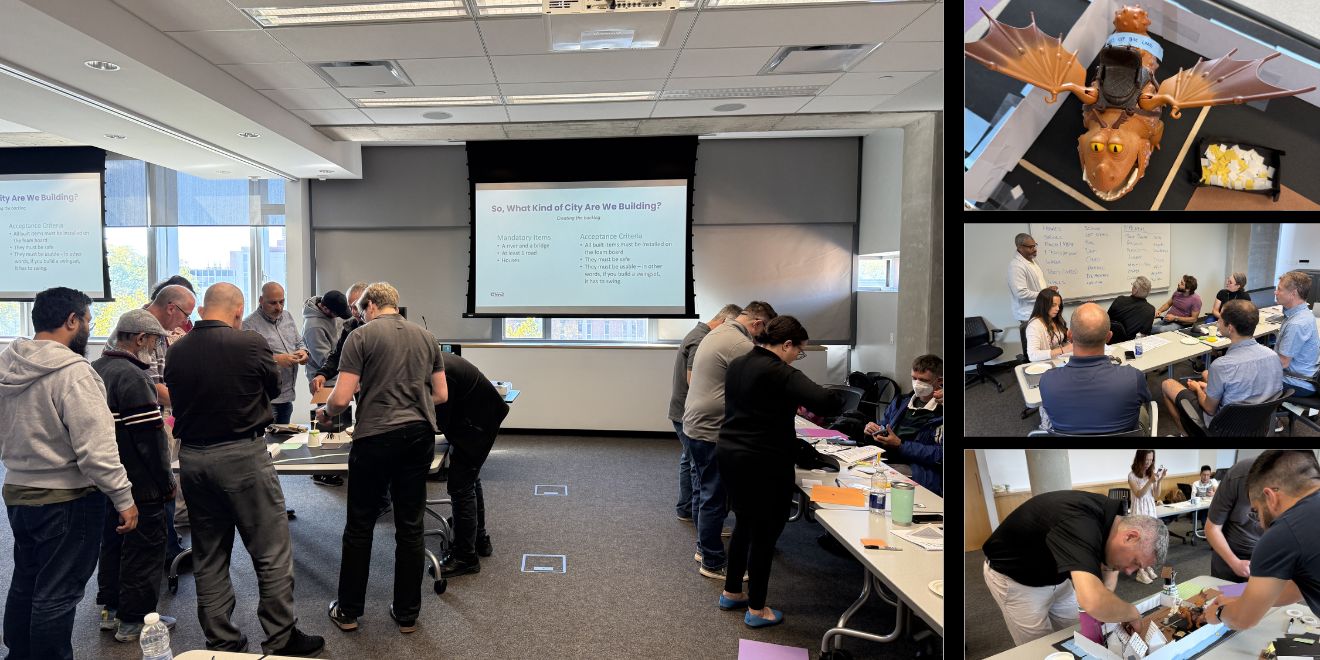
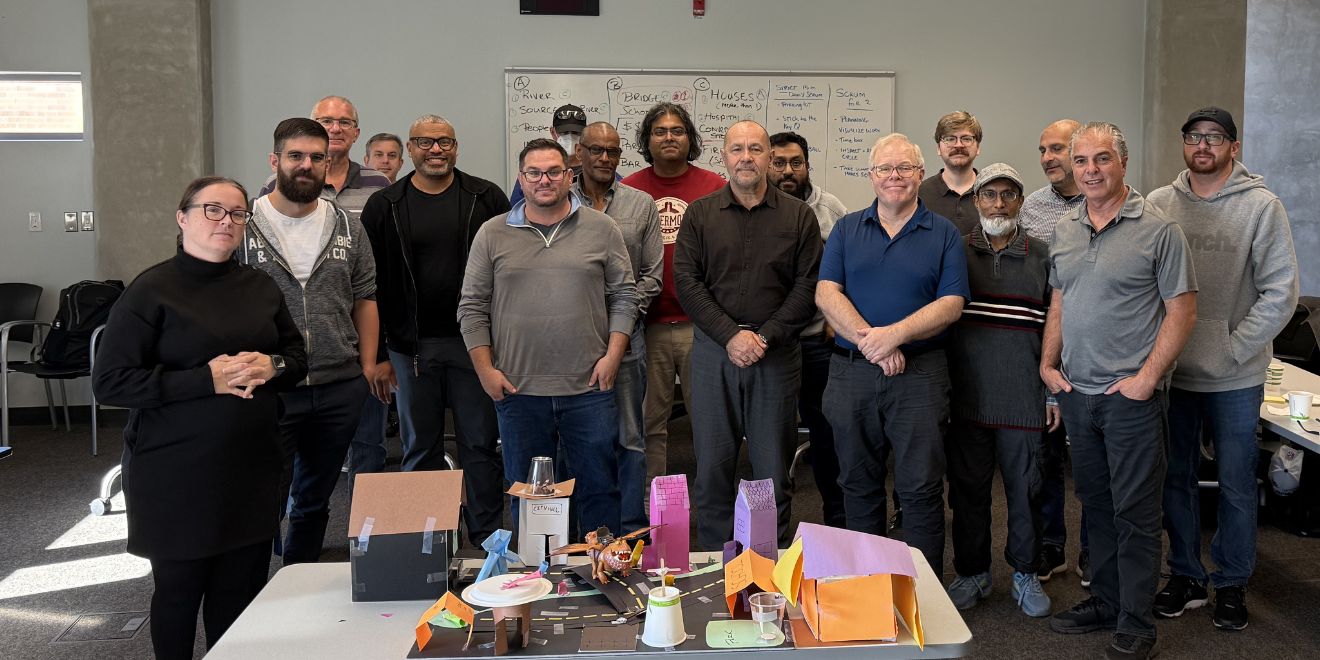
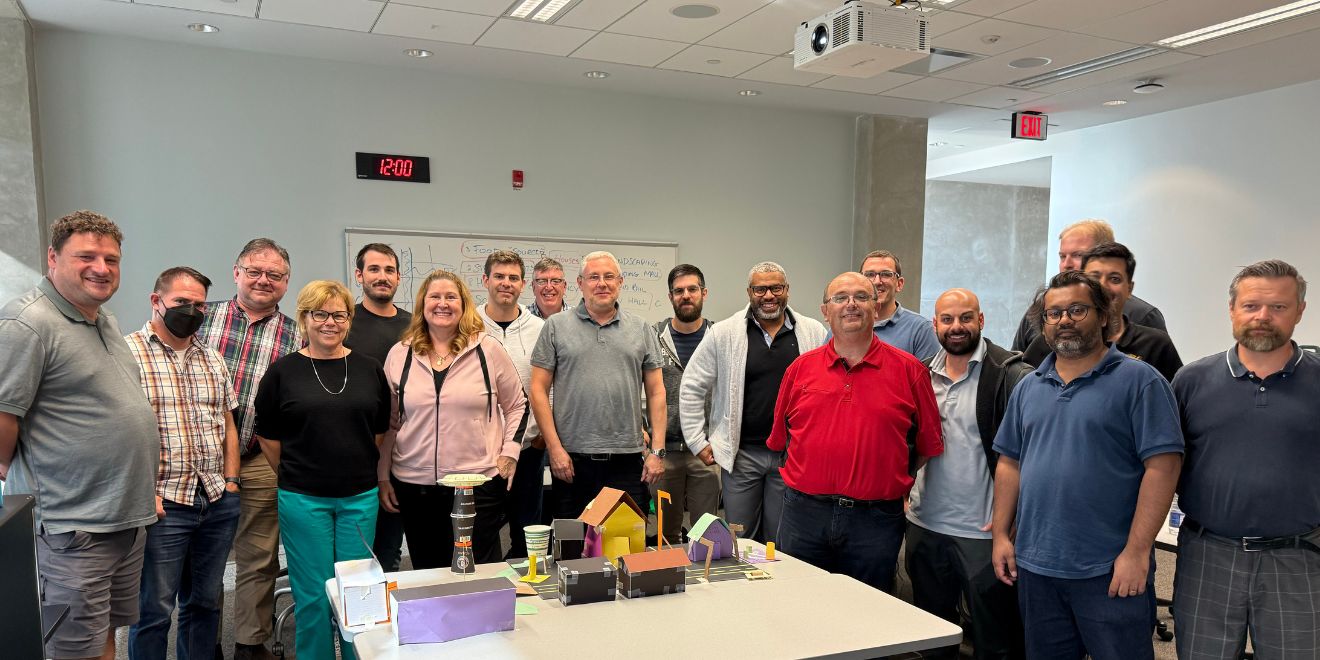
Teams put Scrum to the test while building cities of legendary proportions.
Scrum FUN-damentals
Salvador connected with Laura McCabe at CWE to explore whether Scrum training could help build that shared language for the IT teams, the Product Owners and the university leadership. For Scrum to stand a chance, people need to understand their roles “your AVP has to understand why he can’t have this in 2 weeks,” said Pulcer “we need a common understanding that if we’re in a sprint, the teams will protect their focus and their commitment to the current work items.” “Support must go all the way up,” Bertrand agreed. “We need that acceptance to endorse a shift like this.”
In the month of October, IT demonstrated their commitment and CWE delivered:
- Three full-day sessions for IT teams
- One full-day session for current and future Product Owners
- One condensed session for executives
Instead of a theory–heavy lecture, CWE helps people feel what it’s like to “do scrum”. The Scrum Fundamentals workshop is designed to give teams space to try it out through exercises and games that put the framework in people’s hands.
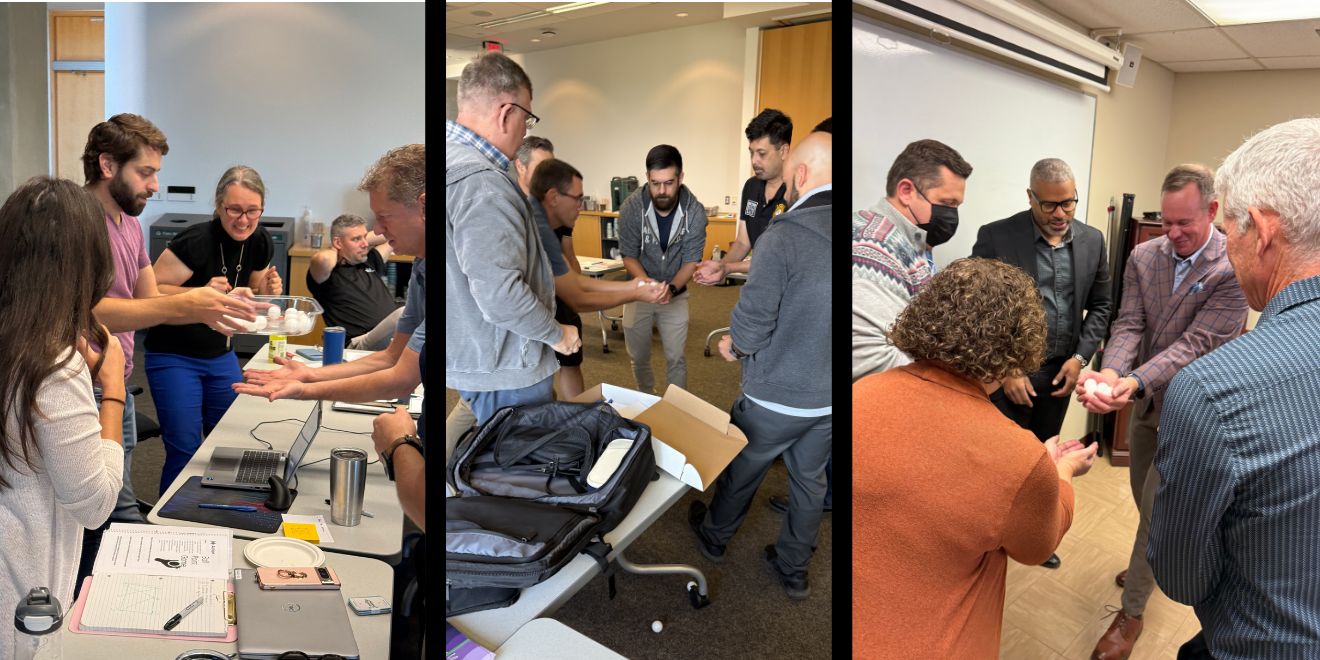
When the lights go on – the Ball Point Game in action.
Humans remember what we experience – and experience is active. It’s what we do, what we uncover, what we experiment with and what we apply. And underneath all of that are the emotions that underline it all. When you can connect a concept with an emotion and an experience, it becomes very sticky. It creates a shared shorthand. Phrases like “don’t drop the ball” and “design for dragons” cue memories for entire exercises, and how teams applied their creativity to meet their challenges.
“The Ball Point Game was where I consistently saw the lights come on for people,” Bertrand reflected. “People discovered that the incremental approach works.” Pulcer agreed, “It illustrates the Scrum cycle in action and everything you learn afterwards gives context to what you experience in the game. Play was a powerful part of the process.”
By the end of the day, people were leaving with new connections, an increased willingness to put their questions out there, and shifts in how they were thinking about their work.
Cultural Shifts
The university set out to address ownership, prioritization and communication through a Scrum lens – but ultimately, we wondered if it was possible to see a cultural shift so early.
The plan after the initial Scrum Fundamentals workshops was to continue internal sessions with departments across campus, with the first departments starting sprints in late February. The university has several Scrum Masters in their ranks who are providing guidance to teams and new product owners. At the writing of this, internal support and training are ongoing.
A Shift in Ownership
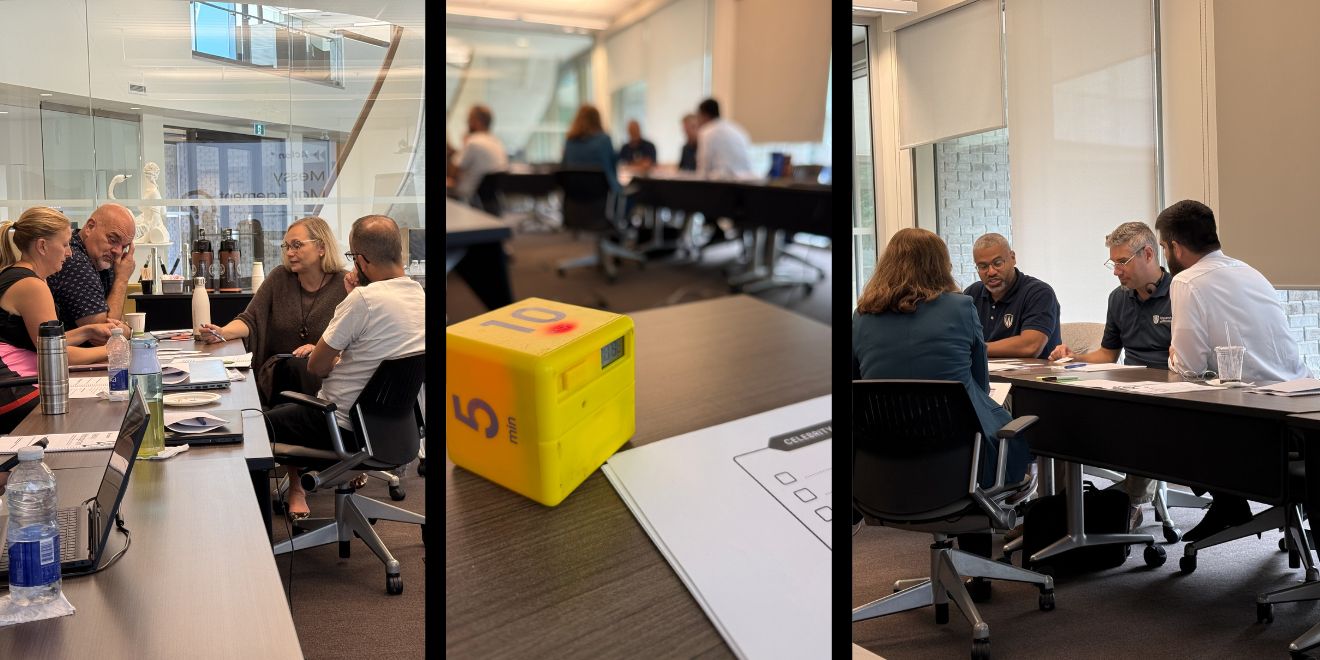
Future Product Owners working out prioritization – which celebrities will be saved from the sinking cruise ship? Time is running out.
“Our Product Owners have a greater knowledge of what’s going on in their projects on the day-to-day level, which gives them better insight,” Bertrand said. Scrum’s structure requires clarity, starting with how requests are framed. IT uses a simple template that helps departments to articulate their needs.
“I need a ____ to do ___ because ____”.
“That way we don’t end up doing a lot of work on a one sentence proposal.” Bertrand added.
The Centre for Teaching and Learning, the first external department to join the pilot, is already engaging IT differently. They approach Salvador saying, “we’ve got ideas, when’s our next sprint?” It reflects forward thinking and an excitement for collaborating with IT.
Change for the developers is showing up in how they approach their work. “It’s bringing the group together,” Salvador noted. “They feel a shared responsibility and don’t want to disappoint the team.” Previously, when someone was stuck, the issue would travel upward. Now the team turns to each other and the phrase, “I’ll show you how to do it,” is common.
A Shift in Communication
“Across our team they’ve really embraced it. When we struggled with Scrum, the team came back even better,” said Salvador. “They are learning how to engage better, and they’re showing value to others.” Team members who tended to self-deprecate don’t do that anymore. They simply say, “I’ve got a question.” It is reflecting a growing confidence and trust inside the teams.
“We see evident growth.” Bertrand agreed. “People speak up, shoulder the load. We see people coming out of their shells.”
Improved communication is changing how teams work together, and how they’re interacting with the outside world.
One of the goals of adopting Scrum is to make work more visible, to help people understand what work IT is doing and what’s coming up. The prioritized list of work items is a visible roadmap allowing IT to explain what they’re working on and why.
When work is transparent, conversations shift from “no” to “not yet, and here’s why”.
Increased clarity reduces friction.
A Shift in Culture
What started as a four-person pilot is now influencing how IT is communicating across campus.
The framework provides structure that helps guide how work is planned, discussed and delivered. It is helping departments understand capacity on both sides of the productivity chain. Instead of looking at each request in isolation, teams and the departments they are serving have a mechanism for talking about value, timing and trade-offs.
The Adventure Continues
Supporting an entire university means living with competing priorities. That will never change.
What can change is how those priorities are surfaced, discussed and delivered.
Through small experiments, shared language and investing in people the University of Windsor is moving toward visibility, trust and collaboration that will embrace the complexity of its environment.
Scrum doesn’t eliminate competing priorities. It includes discipline around them.
It gives focus. It invites collaboration. It allows people to share thoughts and ideas and creates a space to test and refine them.
When asked what advice they would offer to others considering a similar journey, their answers were practical.
Leadership alignment is critical. Support must extend upward if the change is going to last.
Patience matters, too. “Accept when it doesn’t work at first,” Salvador said. “It will take time. There will be failures.”
“Don’t just teach IT,” Bertrand added. “Teach the people who will interact with the team.”
And start small.
“Pick an area, and a manager,” Pulcer advised. “And engage with CWE.”
Signalling Something Bigger
For the University of Windsor, working with CWE signalled something bigger than introducing a process change. It was a commitment.
IT isn’t just a function, it is a human engine powered by problem-solvers, collaborators and builders. When leadership invests time in how teams work, not just what they produce, it sends a message.
Your skills are important. Your experience at work is important. Your creativity is needed and welcome. We want you to take time to sharpen your axes, instead of dully chopping away. We believe in your intelligence and capability, and we want to see you thrive.
In complex environments, people are the most constant factor. Investing in them is leadership.
What is Scrum?
Scrum also clarifies who is responsible for what:
- The Product Owner sets priorities and represents the needs of the people who use the tool or service.
- The Team delivers the work and solves problems together.
- The Scrum Master supports the process, removes blockers, and helps the team keep improving.
At the end of each sprint, the team reviews what was completed and adjusts based on what they learned—so the work stays aligned with real needs, not assumptions.
Scrum is a simple framework that helps teams deliver important work in a world where priorities constantly change.
Instead of trying to plan everything upfront, Scrum breaks work into short cycles called sprints (often two weeks). At the start of each sprint, the team agrees on a small set of priorities to focus on. During the sprint, work is kept visible, progress is checked regularly, and the team avoids constant task-switching.
Meaningful, stress free change starts with engaging your team in collaborative communication. Find out how CWE can facilitate the those conversations by learning more about membership today.